Financial Capital Strategy
Financial Capital Strategy
Initiatives for improving PBR
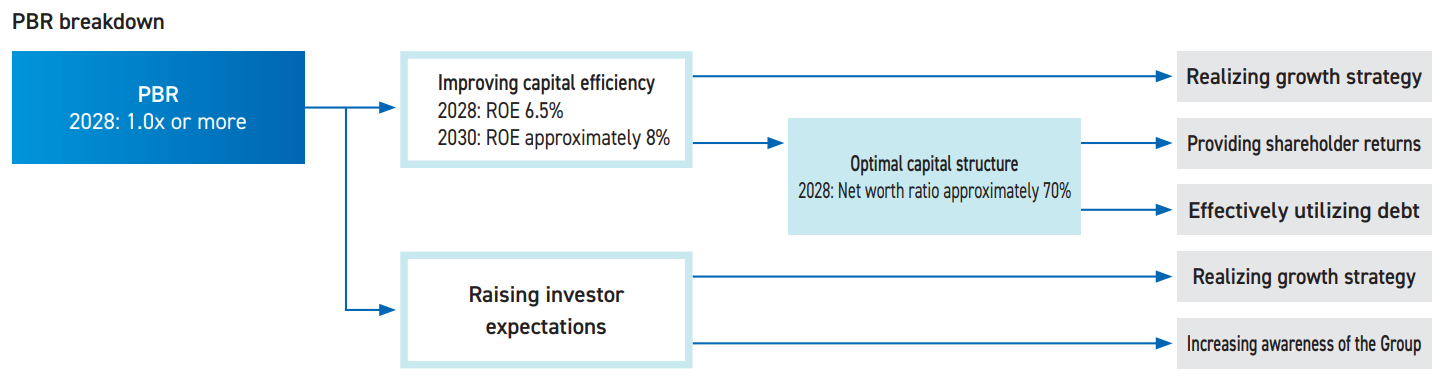
In February 2026, we renewed our initiatives for improving PBR (price book-value ratio) as a means of achieving management with a focus on capital costs and share price.
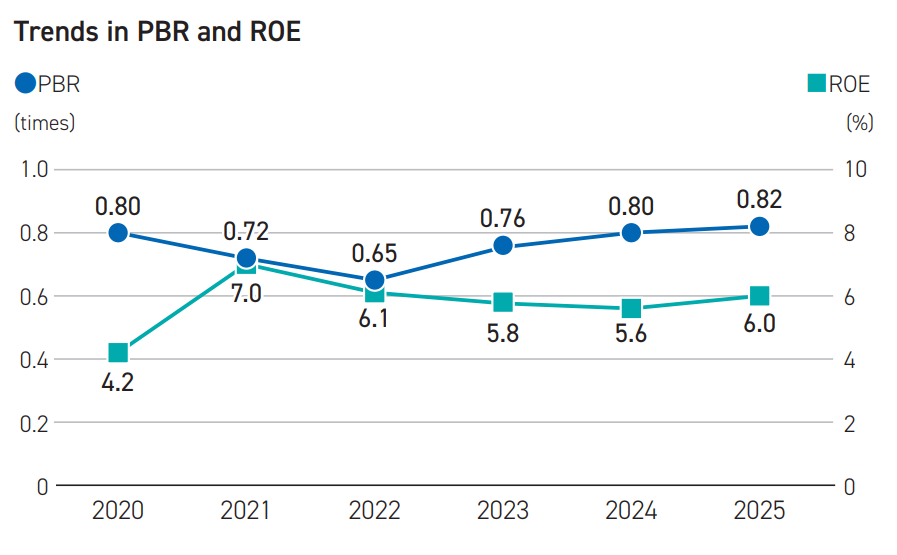
The Toagosei Group’s PBR has stagnated below 1.0x since 2018, despite our efforts to improve it. Upon analysis, we believe that this has resulted from our ROE slumping due to the imbalance between our operating income and net worth. While we have been actively focusing capital investments in high-performance products, it has taken time to monetize these investments through operating income.Meanwhile, we are effectively utilizing shareholder returns and debt to control net worth, and the delayed monetization of our
investments has impacted return on capital.
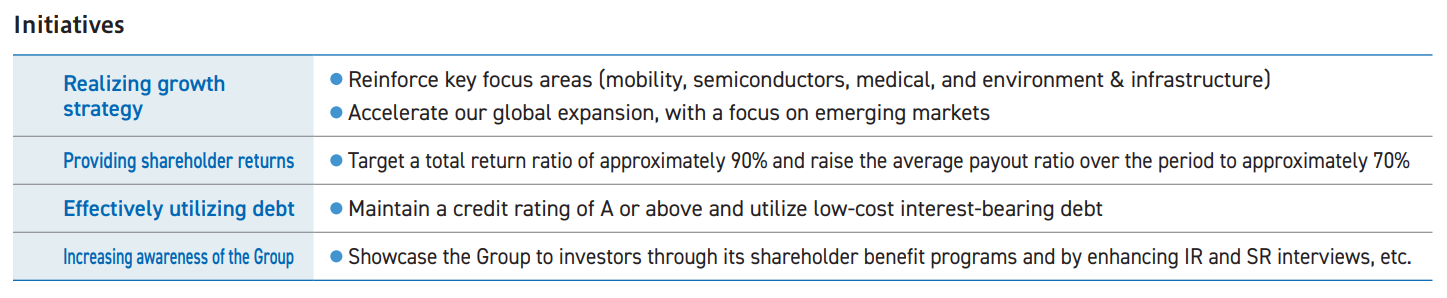
Going forward, we will provide shareholder returns and effectively utilize our debt to control capital and achieve an optimal capital structure. At the same time, we will realize our growth strategy by reinforcing key focus areas such as mobility and semiconductors and by promoting overseas expansion, which will improve our capital efficiency. In addition to realizing our growth strategy, we will raise expectations and market valuation among investors by increasing awareness of the Toagosei Group through the shareholder
benefit program, IR activities, and SR activities.
Cash allocation
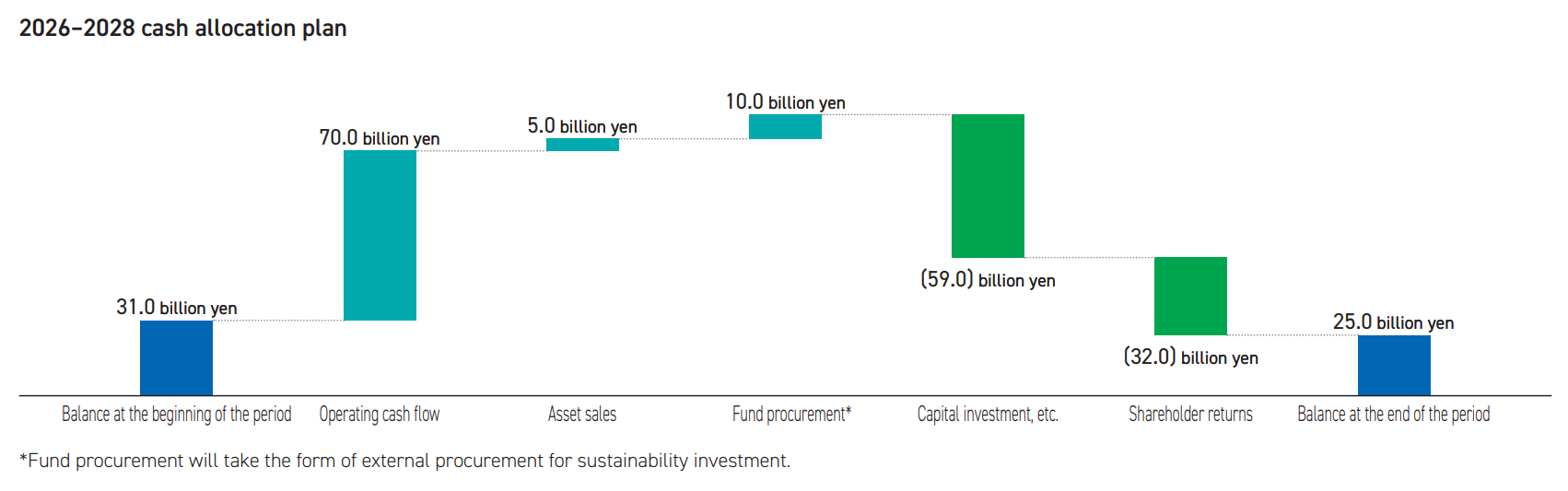
Previously, we implemented capital investments for growth and shareholder returns using cash on hand, operating cash flow, and debt procurement. In order to achieve our 2028 targets (PBR of 1.0x or more), we will continue to implement active capital investments and ongoing shareholder returns, while aiming to improve capital efficiency. We envisage our cash allocation until 2028, based on these factors, as follows. We plan to use operating cash flow through 2028 as the primary funding for capital investment and shareholder returns, and we also plan to procure some funds by procuring interest-bearing debt to improve our capital efficiency.
Through these efforts, we will strive to enhance corporate value over the medium and long term by improving both profitability and capital efficiency.
Improving capital efficiency
Strengthening shareholder returns
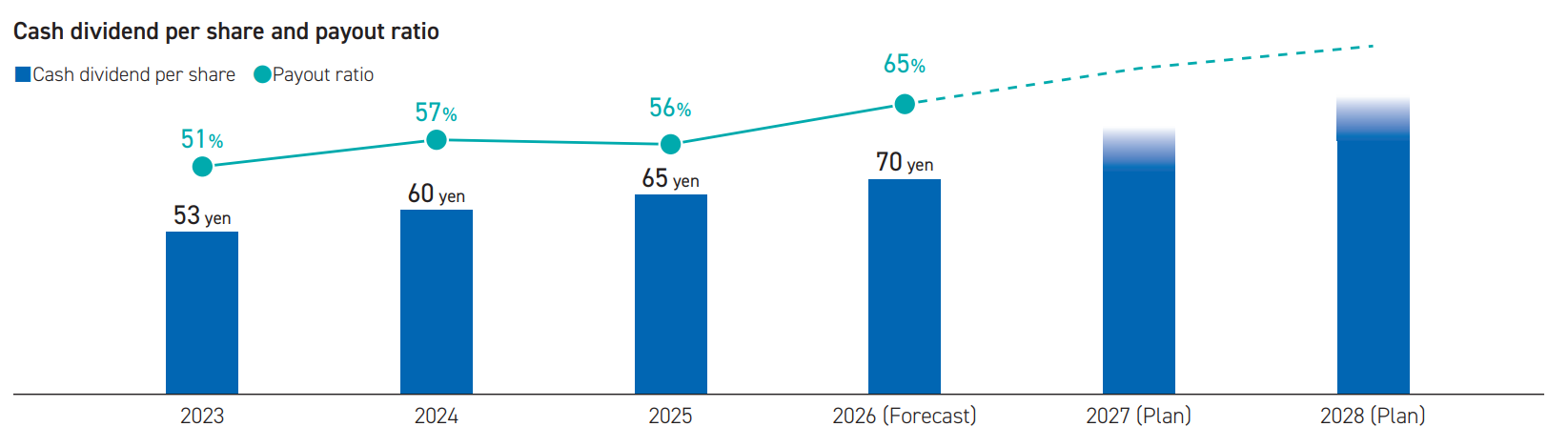
The Company’s basic policy for shareholder returns is to maintain stable dividends and increase the consolidated total return ratio, aiming for a consolidated payout ratio of approximately 30% and a consolidated total return ratio of approximately 50%.
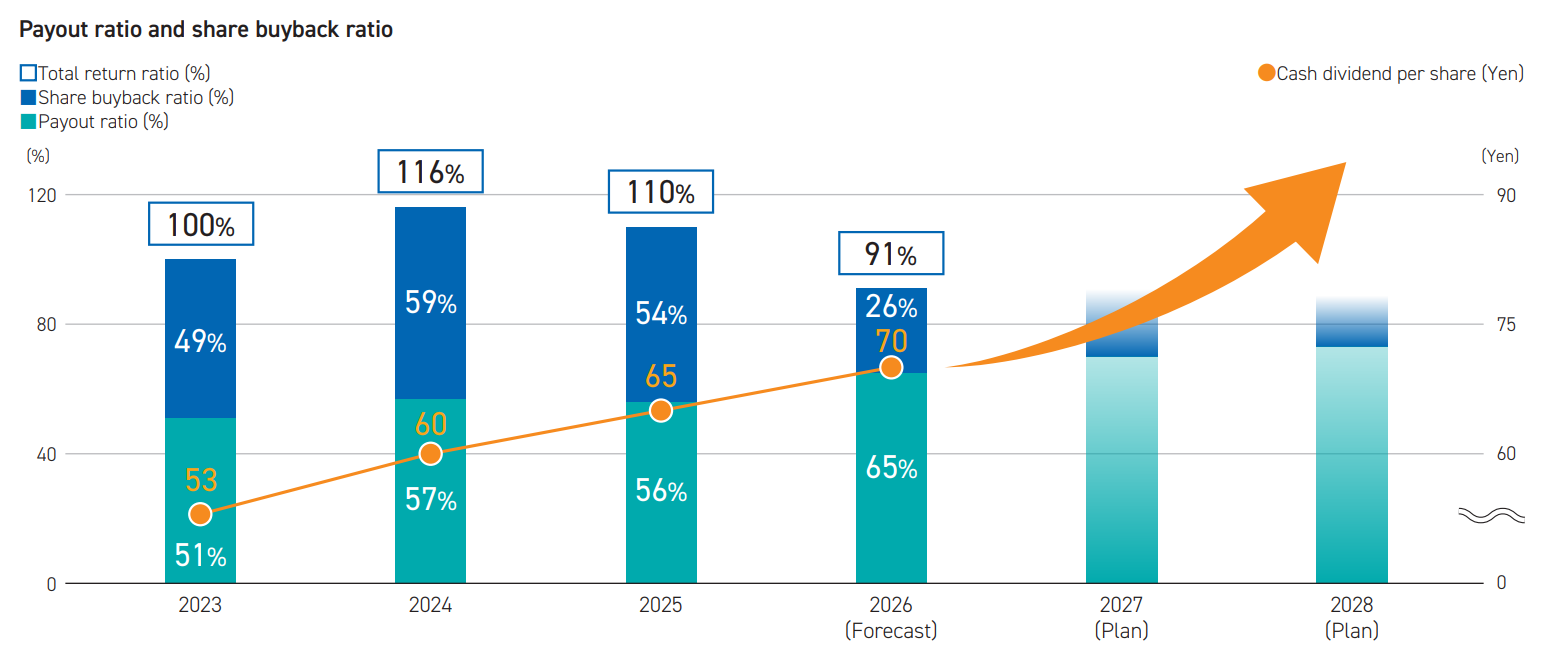
In 2025, the Company increased the annual dividend based on this policy to 65 yen per share (+5 yen year-on-year), and bought back approximately 7.0 billion yen of its own shares. As a result, the consolidated payout ratio was 55.5% and the consolidated total return ratio was 110.1%.
During the Medium-Term Management Plan from 2026 to 2028, we will aim for a total return ratio of approximately 90% and raise our average payout ratio over the period to approximately 70%.
Selling off cross-shareholdings
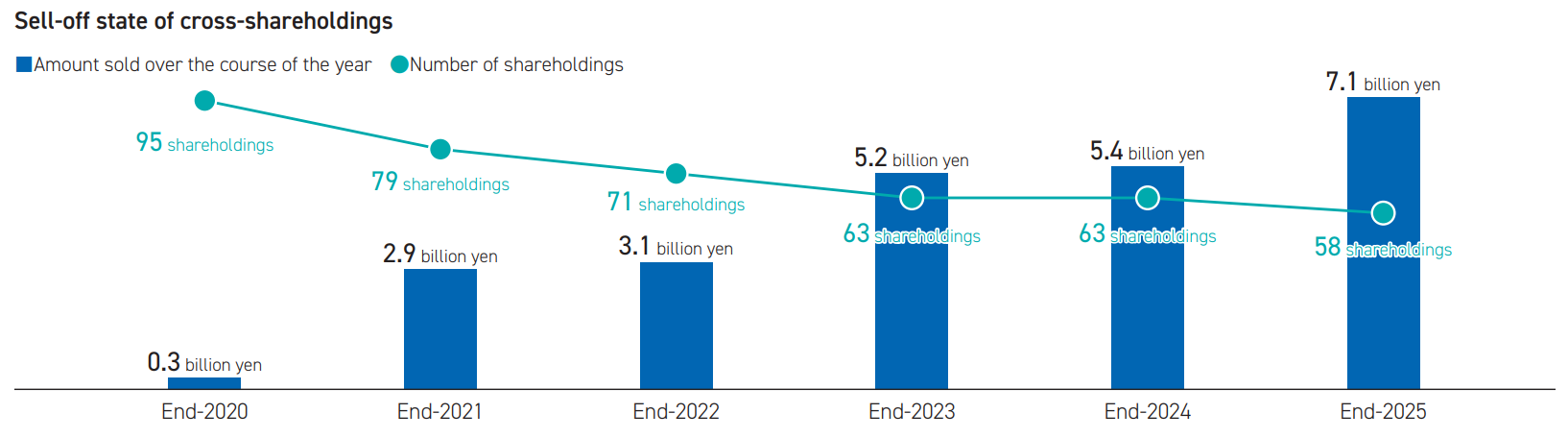
Cross-shareholdings have been sold off to ensure that the amount of shares owned through cross-shareholding is less than 10% of the consolidated net assets on the balance sheet.
The Company acquires and owns shares of its business partners if it has determined that they contribute to increasing the mediumto long-term corporate value of the Company from the perspective of factors such as maintaining better relationships with those business partners or building up business alliances. We annually review the effectiveness of our holdings, taking into consideration whether the benefits and risks associated with maintaining and strengthening the overall relationship with the relevant counterparty
and holding shares are commensurate with the cost of capital.
We sold off a total of 7.1 billion yen of cross-shareholdings with lower holding effectiveness in 2025. We will continue to sell off shares of brands determined to have diminished effectiveness in the future.
Increasing awareness among individual investors
Introduction of shareholder benefit program
To encourage shareholders to retain their shares long term, we have introduced a shareholder benefit program.
Our business is a primarily B2B-oriented, and raising awareness among individual investors has always been a challenge. Through our shareholder benefit program, we seek to increase awareness and, consequently, our share price. We hope that long-term stock holdings by individual investors will help stabilize our share price when market volatility is high.

Through the shareholder benefit program, we present shareholders with Aron Alpha instant glue to deepen their understanding of our business
Message from the CFO

What led to the strong focus on “management with a focus on capital costs and share price” in the 2028 Medium-Term Management Plan (hereinafter the “new Medium-Term Management Plan”)?
During the 2025 Medium-Term Management Plan (hereinafter the “previous Medium-Term Management Plan”), we continued to actively invest in future growth, such as by investing in R&D, capital investment, and human capital. As a result of these efforts, we succeeded in steadily strengthening our technical capabilities and business base, but our business was affected by the market environment, and our capital investments did not always produce sufficient profitability improvements.
Our ROE has remained around 6%, and our PBR below 1.0x. We have not been able to fully live up to expectations for the returns of our growth investments to exceed their capital costs, and that has caused our market valuation to struggle. I believe we need to take this seriously as a management issue.
Based on that recognition, in addition to promoting our growth strategy, one of the things we have positioned as a pillar of our new Medium-Term Management Plan is to stay clearly conscious of capital costs and evolve our management to provide a clear sense of our corporate value improvements.
As CFO, where do you place the greatest emphasis with respect to improving capital efficiency?
I place the greatest emphasis on establishing an organizationwide approach of making management decisions with a focus on capital efficiency.
Going forward, when making decisions about investments, we need to pay very close attention not only to growth potential, but also the recoverability of the investment and return on capital. For the growth investment we are already implementing, we have to speed up the monetization and tightly link to profit.
Another important task will be to review our business portfolio. We will clarify the priorities of our businesses from the perspectives of profitability and growth potential, and we will carry out selection and concentration to improve our asset efficiency and our capital turnover ratio. I want to firmly establish management with a focus on indicators such as ROIC and ROE in our Group’s everyday decision-making.
What kinds of policies will you be advancing to achieve an optimal capital structure?
So far, our Group has maintained a relatively high net worth ratio, but in the future we plan to utilize appropriate financial leverage, without damaging our financial soundness.
In addition to reducing our cross-shareholdings and our total assets, we will maintain a credit rating of A or above so that we can engage in steady, low-cost fund procurement.
By doing so, we will aim for a PBR of 1.0x or higher and an ROE of 6.5% in FY2028. These targets are all milestones, and we will further improve our capital efficiency as we head towards 2030, becoming a company that is consistently recognized by the market.
What is the new Medium-Term Management Plan’s stance with respect to shareholder returns?
I believe that providing returns to shareholders is an important method of concretely demonstrating the results of corporate value improvement measures.
The new Medium-Term Management Plan reappraises our payout and share buyback ratios. It raises the average payout ratio over the period to approximately 70% while also flexibly
acquiring treasury shares. It also targets the total return ratio at approximately 90%, and we will continue to provide shareholder returns with an emphasis on stable dividends.
In addition, through our shareholder benefit program, we will provide shareholders with a greater understanding of our Group’s products and our businesses, striving to expand our base of shareholders who will support us over the medium to long term.
Do you have any final words for our stakeholders?
While our business environment continues to be marked by heavy volatility, we have technical capabilities primarily focused on materials and functions, along with a diverse business portfolio.
As CFO, I think my greatest duty, going forward, will be to not only connect these strengths to growth investment, but to also steadily produce returns.
By refining and elevating our financial and capital policies and by transparently disclosing information, we will engage in deeper dialogue with the market and work to sustainably increase our corporate value. I look forward to the ongoing support and understanding of our shareholders, our investors, and all other stakeholders.